
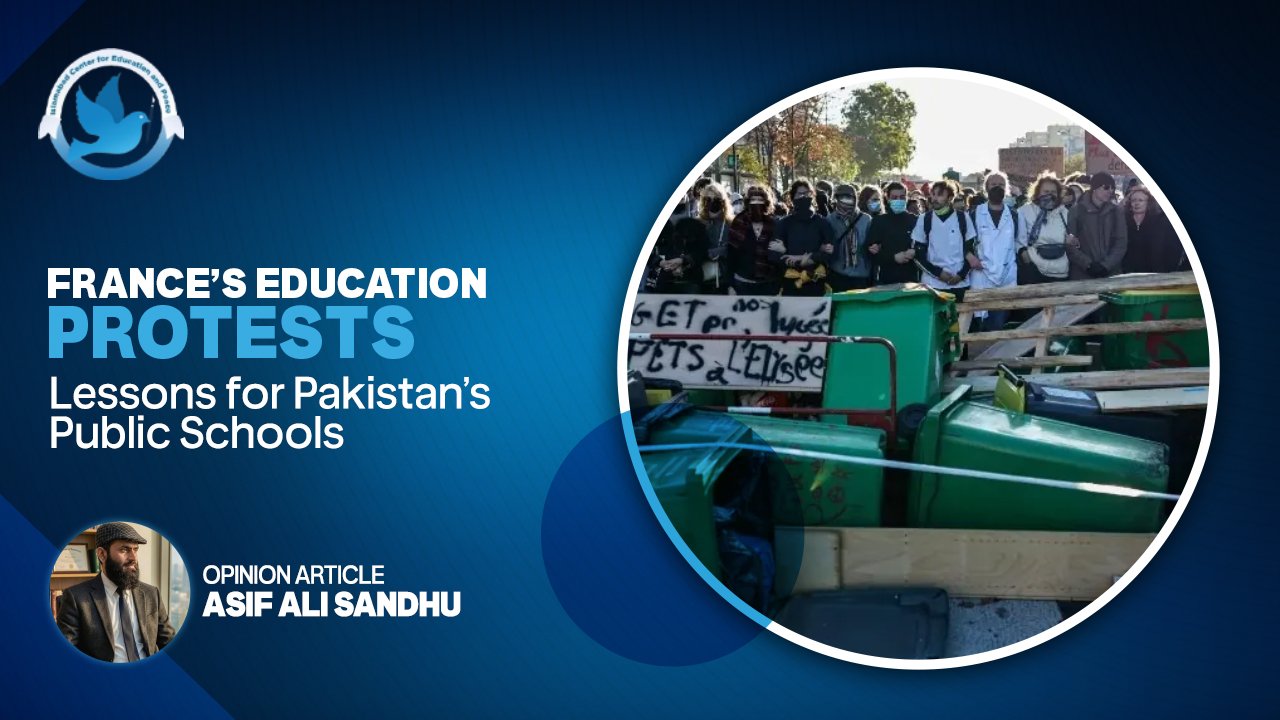
Students and teachers at a high
school in Créteil, southeast of Paris, protested on 17 September 2026 over
staffing shortages and dilapidated buildings. Within days, videos of the
demonstration circulated widely on social media, prompting students in other
cities to follow suit. By early October, protests had spread to Paris, Lyon,
Marseille, Nantes, Rennes, and Strasbourg, developing into one of France's
largest student mobilizations in years.
On 1 October, the movement expanded
nationally as an increasing number of schools closed and demonstrations
multiplied. The following day Le Monde reported that over 1000 schools had
joined the action. By 6 October teachers and parents joined students on the
streets. Reuters reported that more than 250,000 people took part nationwide,
with police deploying tear gas amid clashes in several cities. Police estimates
indicated that approximately 71,500 people demonstrated on 8 October.
This unrest is not directed at a
single legislative act; rather, it reflects daily structural failures within
the public education system. Staffing shortages are the primary grievance. When
a teacher is absent substitute coverage is rarely available, leading to missed
instruction. According to figures from the French Ministry of National
Education public high schools face instructional gaps amounting to roughly 10% of
total class hours.
Facility conditions are another
major concern: protesters cited crumbling infrastructure, while Reuters
documented issues ranging from water leaks to rodent infestations. Other
grievances include overcrowded classrooms, a long school day (running from 8:00
a.m. to 6:00 p.m.), and short lunch breaks.
Two broader structural issues drive
these problems:
1.
Fiscal
constraints: High public debt and budget deficits have forced the government to
balance educational spending against other national priorities.
2.
Growing
inequality: Pierre-Vincent Guéret head of the Catholic private-school body in
France told Reuters that private school students have begun transferring into
the public system potentially concentrating a higher proportion of less
affluent students in under-resourced public institutions.
The protesters’ demands can be
grouped into five areas:
1.
Addressing
teacher shortages and funding public schools adequately.
2.
Repairing
school buildings and providing basic amenities’
3.
Restructuring
the school day and extending lunch breaks’
4.
Ensuring
equitable, quality education regardless of region or socio-economic background.
5.
Formalizing
student representation in educational policymaking.
On 9 October, Reuters reported that
the ministry planned to recruit roughly 3,000 qualified teachers for schools in
greatest need at a cost of tens of millions of euros. Prime Minister Sébastien
Lecornu instructed ministers to present proposals addressing teacher shortages,
school timetables, lunch hours, and building renovations by the end of October.
The ministry’s 2027 stated priorities focus on smaller class sizes improved
infrastructure, student safety and reformed teacher recruitment and training.
While student groups acknowledged these measures as a starting point protests
continued with further nationwide demonstrations scheduled for 13 October.
The unrest has also seen incidents
of violence. On 6 October Reuters reported that the Interior Ministry had
arrested 6,100 individuals since the start of the protests, with the Justice
Ministry initiating proceedings against more than 1,800 people, including 1,483
minors. According to the Prime Minister’s office over 215 young people, 85
school staff members and more than 700 police officers sustained injuries. By
14 October, 141 schools remained closed. While the government characterized
some demonstrations as "civil disorder" caused by outside agitators,
student groups, parents and human rights organizations raised concerns
regarding police conduct, particularly toward minors.
The dispute has also become
politically charged ahead of the 2027 presidential election. Union leader
Jean-Rémi Girard warned against politicizing the demonstrations, stating
"Let's not use the protests as a political tool. There are some protesters
that are peaceful and others that are violent; mixing them up skews the
reality."
Relevance for Pakistan
Pakistan faces different and, in
many respects, more foundational challenges that basic access, enrollment and
fundamental literacy. The country continues to grapple with an out-of-school
population estimated in the tens of millions. However, the grievances seen in
France regarding infrastructure, staffing, and management resonate closely with
conditions in Pakistan’s public schools.
Addressing these challenges requires
targeted reforms at the institutional level:
·
Develop
district-level substitute teacher pools track and display teacher attendance
transparently at the school level recruit on open merit and offer incentives
for hardship postings in remote areas.
·
Conduct
comprehensive audits of basic facilities clean drinking water, functional
toilets, electricity, boundary walls and structurally sound buildings supported
by dedicated, non-lapsable annual maintenance grants for each school.
·
Enforce
rational class-size limits, address double-shift constraints, and allow local
administrative flexibility in school hours to account for extreme weather and
travel conditions. Expanding targeted school meal programs in vulnerable
districts would also support child nutrition and student retention.
·
Allocate
funding to disadvantaged public schools via needs-based formulas, regulate
low-fee private schools for safety and quality standards, and expand
stipend-supported community schooling models to bring out-of-school
children—especially girls into classrooms.
·
Empower
School Management Committees (SMCs) with functional budgets, establish student
councils in secondary schools, and institute time-bound grievance redress
mechanisms.
·
Fulfill
the state's constitutional obligation under Article 25A by securing sustainable
budgetary allocations for public education, supported by transparent,
school-level data systems.
The unrest in France illustrates how
long-standing neglect in public education can eventually boil over. For
Pakistan, meaningful reform must begin in the classroom: ensuring a qualified
teacher is present the building is
secure, class sizes are manageable and the school administration is accountable
to the community it serves.