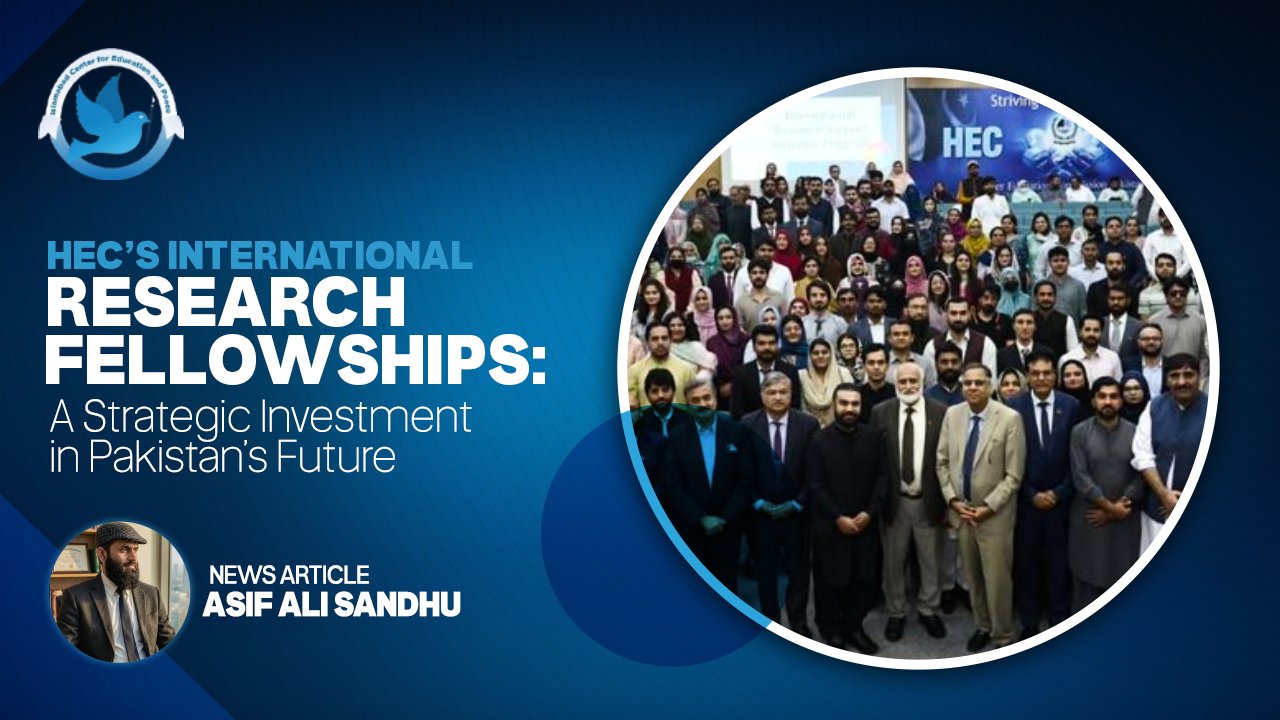
The Higher Education Commission
(HEC) of Pakistan has awarded 186 international research fellowships under the
International Research Support Initiative Programme (IRSIP) Batch 59, providing
Pakistani PhD scholars with opportunities to gain valuable research experience
at leading universities abroad. This initiative represents a positive step
towards strengthening Pakistan’s higher education system promoting academic
excellence and developing the research capacity needed to address the country’s
evolving challenges.
The fellowship award ceremony was attended by Chairman HEC Professor Dr. Niaz Ahmad Akhtar, who served as the chief guest, Executive Director HEC Professor Dr. Zia Ul Haq, senior HEC officials, vice chancellors, faculty members, awardees and their parents. Addressing the ceremony, Chairman HEC Professor Dr. Niaz Ahmad Akhtar emphasized merit, transparency and human capital development, highlighting the importance of producing impactful research while upholding national values. Executive Director HEC Professor Dr. Zia Ul Haq also underscored the programme’s contribution to academic advancement and national development, reaffirming HEC’s commitment to a transparent, merit-based selection process.
Launched in 2006, IRSIP has
supported more than 6,900 scholars through six-month international research
fellowships. The programme enables doctoral researchers to access advanced
research facilities, establish international academic networks and collaborate
with researchers at leading institutions. HEC has also announced the opening of
applications for the next batch, demonstrating its continued commitment to
expanding research opportunities for Pakistani scholars.
The Islamabad Center for Peace
and Education (ICPE) welcomes this initiative as an important investment in
Pakistan’s intellectual capital and research potential. In an increasingly
knowledge-driven world, countries that invest in higher education, scientific
inquiry and international academic cooperation are better positioned to develop
innovative solutions, strengthen institutions and achieve sustainable
development.
International research exposure
can help Pakistani scholars acquire advanced methodologies, explore new
perspectives and build lasting academic partnerships. However, the true success
of such fellowships will ultimately depend on how effectively scholars apply
their knowledge after returning to Pakistan. Their experience should translate
into stronger university research programmes, improved teaching, practical
innovation and evidence-based policymaking.
To maximize the benefits of IRSIP
continued institutional support is essential. Universities and relevant public
institutions should facilitate returning scholars through research funding,
modern laboratory facilities, professional mentoring and opportunities to
collaborate with industry and policymakers. Maintaining partnerships with
international universities can further strengthen Pakistan’s participation in
global research networks and encourage the exchange of knowledge across
borders.
Research also has an important
role in advancing peace, education and social development. Evidence-based
research can help address educational inequalities, improve public policy,
promote social cohesion and identify practical approaches to conflict prevention
and peacebuilding. Encouraging interdisciplinary research and cooperation
between academic institutions and civil society can ensure that knowledge
contributes to the wider public good.
HEC’s emphasis on merit and
transparency is equally significant. Fair selection processes help ensure that
opportunities reach deserving scholars and strengthen public confidence in
national education programmes. Consistent monitoring and transparent reporting
of research outcomes can further demonstrate the programme’s long-term value.
The award of 186 fellowships is
therefore more than an academic milestone; it is an opportunity to strengthen
Pakistan’s future through knowledge, innovation and international cooperation.
As the country seeks to improve its educational standards and respond to
complex economic and social challenges, empowering researchers must remain a
national priority.
The Islamabad Center for Peace
and Education supports HEC’s efforts to develop research talent, promote
academic excellence and expand international collaboration. Sustained
investment in scholars, universities and research infrastructure can help
transform international learning into local solutions and ensure that
Pakistan’s intellectual resources contribute meaningfully to a more peaceful,
innovative and prosperous society.