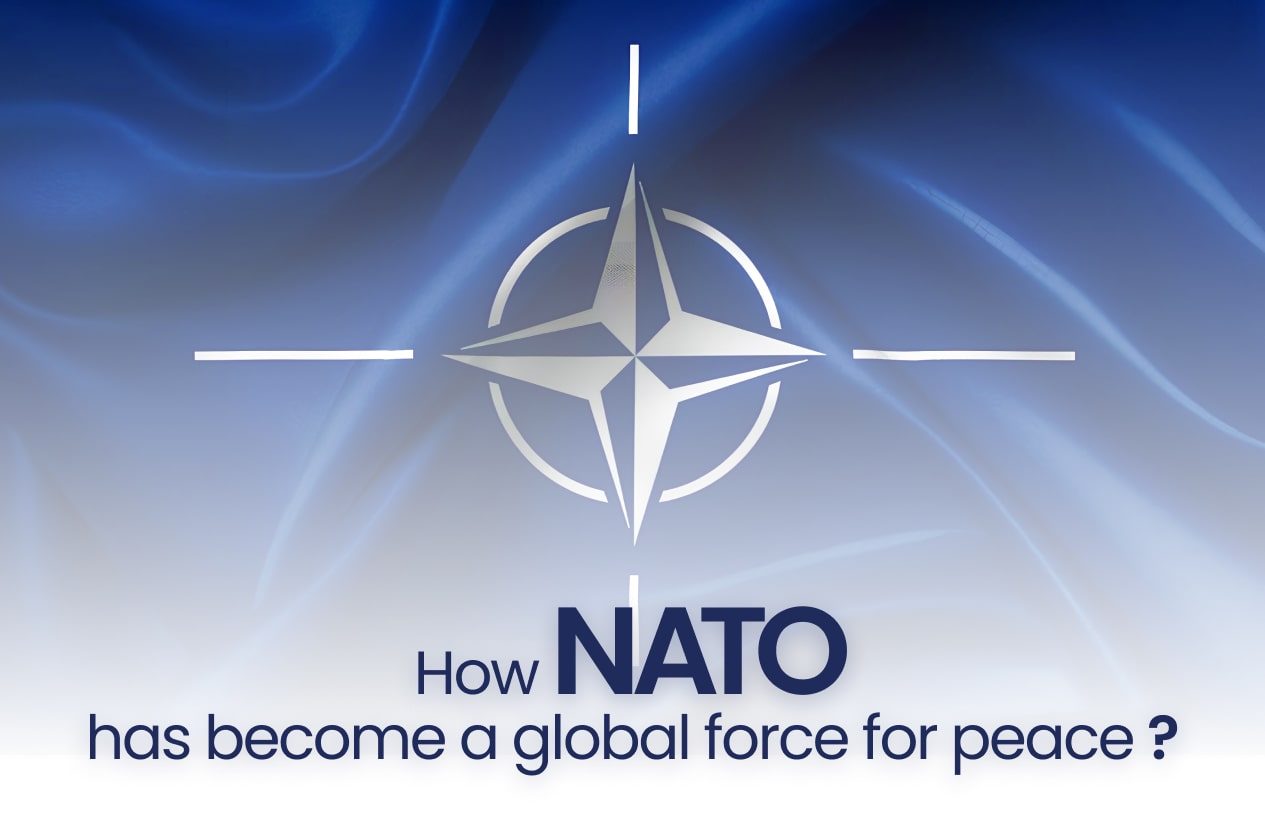

Since its founding in 1949, NATO has been a cornerstone of collective security, uniting 32 member states across Europe and North America under a pledge of mutual defense and political cooperation. Originally created to prevent another devastating war in Europe and to counter the Soviet threat during the Cold War, NATO’s role has steadily evolved. From purely military defense, it has expanded into crisis prevention, peacekeeping, and conflict resolution, addressing conflicts both within and beyond the Euro-Atlantic region.
In today’s rapidly shifting global landscape, NATO’s ability to deploy military, political, and civilian tools has made it a stabilizing force worldwide. Through peacekeeping missions, air campaigns, maritime operations, and diplomacy, the Alliance has played a crucial role in resolving conflicts and maintaining security. However, its expanding role has also drawn criticism regarding sovereignty, burden-sharing, and strategic relevance.
Key Roles and Notable Operations
·
Crisis management and peace support: NATO’s core
tasks go beyond collective defense to include crisis prevention and management.
It uses a combination of political, civilian, and military tools tailored to
the nature and severity of each crisis. Initially focused on deterrence during
the Cold War, NATO’s role evolved after 1990 to include peace support and
conflict resolution in regions beyond its immediate borders.
·
Intervention in the Balkans: The disintegration
of Yugoslavia forced NATO to step beyond its traditional role. In 1995, during
the conflict in Bosnia, NATO conducted a decisive air campaign to halt
hostilities and later deployed multinational forces to implement peace
agreements. This effort demonstrated NATO’s capability to enforce peace and
support long-term stability in conflict zones.
·
Kosovo and peace enforcement: In 1999, NATO
intervened in Kosovo to stop widespread human rights abuses, combining air
operations with the deployment of peacekeeping forces to stabilize the region.
This operation marked a turning point, establishing NATO as an actor capable of
both defensive and humanitarian interventions.
·
Global operations beyond Europe: NATO expanded
its role to address non-traditional security threats such as piracy off the
Horn of Africa. These missions protected maritime trade and humanitarian
operations, demonstrating the Alliance’s capacity to project power and maintain
security far from its member territories.
· Institutional adaptation and capability-building: NATO continuously upgrades its structure to meet evolving threats, including the creation of rapid response forces and enhanced interoperability among members. Cooperation with partner nations and regional organizations has also strengthened its ability to resolve conflicts collaboratively.
Challenges and Limitations
·
Internal divisions and burden-sharing: Differing
political priorities and defense spending among members sometimes hinder
unified action. Resource constraints, including limited troop contributions and
funding, can affect operational effectiveness.
·
Sovereignty concerns and legitimacy debates: Some
interventions have raised questions about balancing humanitarian objectives
with respect for state sovereignty, highlighting the delicate line NATO must
navigate when acting beyond member territories.
·
Post-conflict stabilization challenges: Military
intervention alone is rarely sufficient for lasting peace. Effective conflict
resolution requires coordinated political, civilian, and reconstruction
efforts, often over long periods, to prevent renewed violence.
· Adapting to new security threats: Modern conflicts involve cyber warfare, terrorism, hybrid threats, and disinformation campaigns. NATO must continuously evolve to remain relevant and strategically effective in addressing these complex challenges.
Analytical Reflection
NATO’s journey from a Cold War
defense alliance to a global peace-support actor demonstrates the adaptability
of international institutions. Its interventions in Bosnia, Kosovo, and other
regions show a pragmatic approach to maintaining stability, even when questions
of legitimacy and sovereignty arise. Looking forward, NATO’s effectiveness will
depend on three priorities: strengthening burden-sharing among members,
deepening cooperation with regional organizations, and expanding its toolbox
beyond traditional military means to include cyber defense, humanitarian aid,
and post-conflict reconstruction. Ultimately, NATO has the potential to become
a 21st-century guardian of global calm — balancing deterrence with diplomacy,
military readiness with dialogue, and immediate security needs with long-term
peacebuilding. If it achieves this balance, its legacy will be measured not
just by wars prevented but by conflicts transformed.

_6784.jpg)