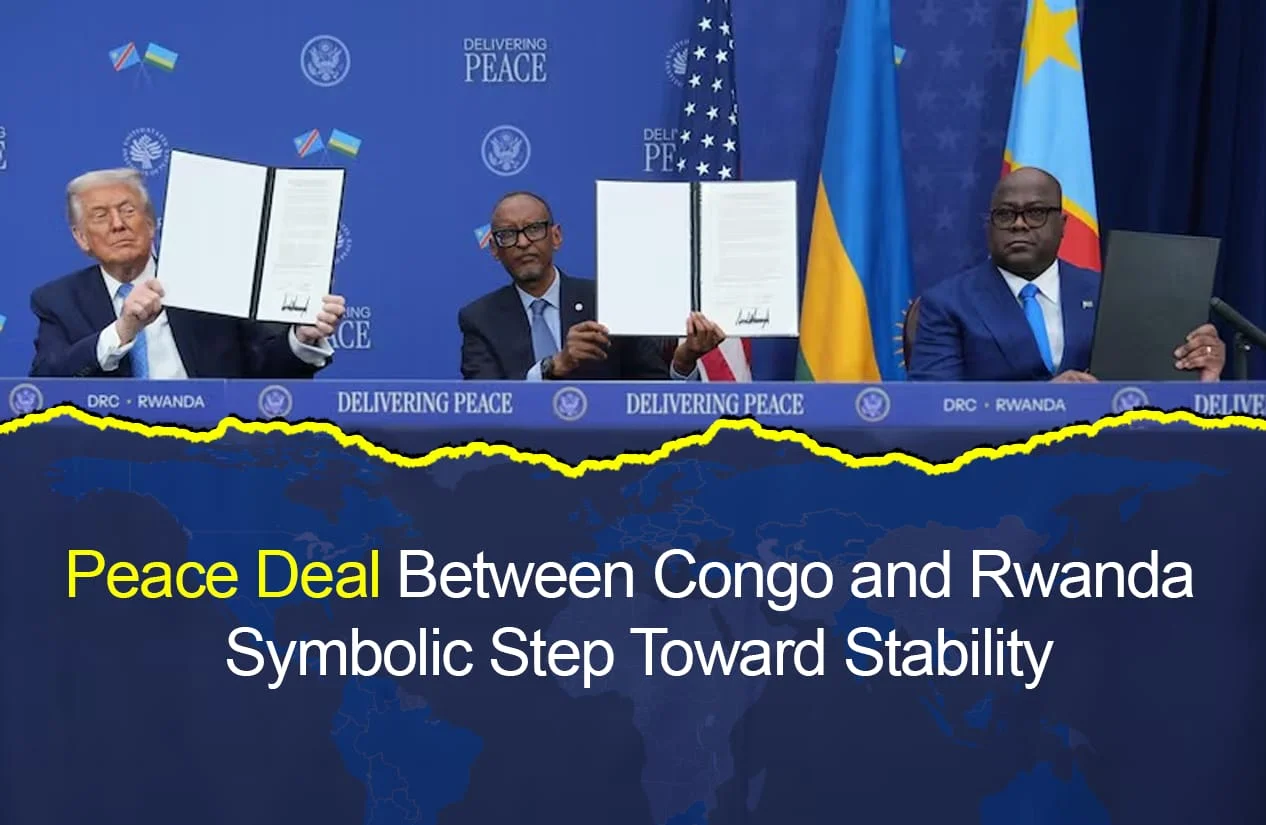

In Washington December 4, 2025, a ceremony at the newly rebranded "Donald J. Trump Institute of Peace," U.S. President Donald Trump presided over the signing of a bilateral peace agreement between the Democratic Republic of the Congo (DRC) and Rwanda. The deal, finalized with Presidents Felix Tshisekedi and Paul Kagame, aims to end decades of conflict in eastern DRC and establish a framework for regional economic integration, with significant involvement from U.S. commercial interests.
Key Highlights of the Peace Deal
• Both Congo (DRC) and Rwanda commit to halting all military operations and supporting an immediate ceasefire in eastern Congo.
• A structured plan for disarming, demobilizing, and reintegrating rebel groups operating in eastern Congo, with international monitoring.
• Rwanda agrees to end all alleged support to M23 and other militias & Congo agrees to prevent hostile militias from using its territory against Rwanda.
• Creation of a Congo–Rwanda Border Security Task Force to manage tensions, intelligence sharing, and patrol cross-border routes.
• Safe corridors to allow NGOs, UN agencies, and medical teams to reach displaced populations in North Kivu and surrounding regions.
• The U.S., African Union, and regional partners will form a Monitoring & Verification Mission to ensure both sides honor commitments.
• A roadmap for strengthening bilateral trade, infrastructure connectivity, and cross-border commerce.
• Congo opens access to key rare-earth and critical mineral projects for U.S. companies.
• Rwanda partners on refining, processing, and logistics development.
• U.S. and international partners to support roads, mining infrastructure, energy, and border-trade hubs.
• Both governments pledge to reduce civilian casualties, curb abuses by local forces, and support displaced citizens’ return.
• Continued high-level political talks every 90 days, hosted alternately by the U.S., AU and regional capitals.
Historical Background of the Conflict
The conflict's roots lie in the aftermath of the 1994 Rwandan genocide. The mass flight of Hutu perpetrators into eastern Congo created enduring militias. Rwanda has repeatedly intervened militarily, citing the need for self-defense against these groups. This dynamic fueled the rise of the Tutsi-led M23 rebellion, which Rwanda has been extensively accused of backing—a claim it denies. The cycle of violence has displaced millions and created one of the world's worst humanitarian crises.
Despite the signing, peace remains distant for civilians. Eastern Congo is fragmented among over 100 armed groups. The M23 continues to hold major cities like Goma, where government services have collapsed and crime has surged. Furthermore, recent U.S. aid cuts have worsened the humanitarian catastrophe. The success of the Washington deal hinges on the genuine disarmament of militias and the withdrawal of foreign forces, steps that have eluded numerous previous agreements.
In Summary:
The December 4th agreement represents a significant diplomatic milestone, leveraging U.S. economic interests to bring regional leaders to the table. However, it is widely seen as a framework for peace rather than its realization. With fighting ongoing and deep-seated mutual distrust, the path from a signed document in Washington to lasting stability in eastern Congo remains "quite difficult," as President Tshisekedi acknowledged.
_6784.jpg)