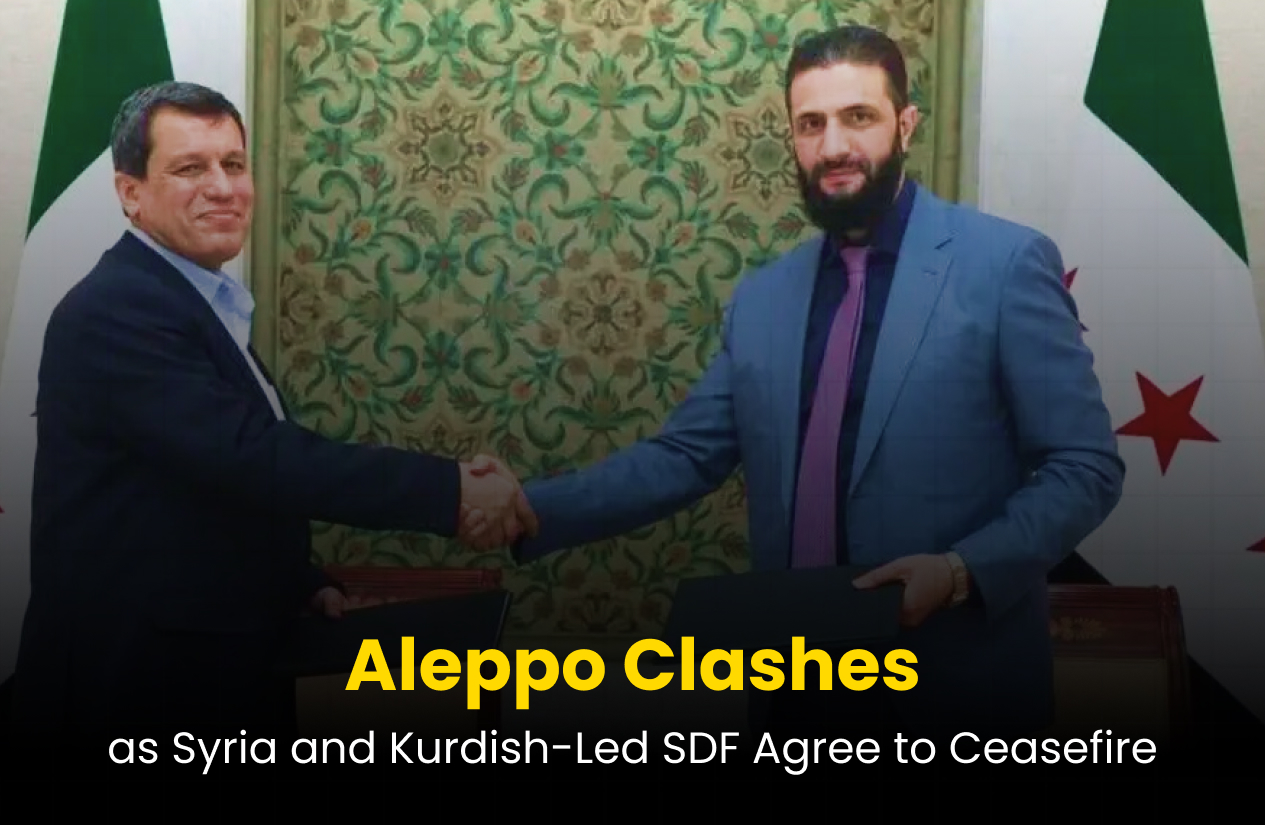

Fighting in
Syria's Aleppo briefly intensified in late December before the Syrian
government and the Kurdish-led Syrian Democratic Forces reached an
understanding to scale down violence. The clashes, which triggered civilian
casualties and a temporary shutdown of public institutions, have underlined the
precarious security situation in northern Syria and the unresolved dispute on
the future integration of Kurdish forces into the Syrian state.
On December
22, fighting broke out between in Aleppo’s Kurdish-populated Sheikh Maqsoud and
Ashrafiyah neighborhoods. Syria's state news agency SANA said the Syrian army
accused the SDF of initiating a surprise assault on government positions;
Syrian forces responded with tank and artillery fire. The Syrian Health
Ministry said at least two civilians died, and several more were injured by
shelling that struck the residential districts of Al-Jamilia and Al-Razi. The SDF
denied the reports, in turn blaming Damascus for targeting civilian areas.
Later on the
same day, SANA reported that the general command of the Syrian army ordered a
halt in fire against positions held by SDF. The SDF later issued a statement
saying it too would cease responding to government attacks-the first sign of a
temporary de-escalation.Though the ceasefire reinstated relative calm, analysts
establish that it does not resolve the root political and military
disagreements between both sides.
The clashes
coincided with an official visit to Damascus by the Turkish Foreign Minister
Hakan Fidan, who said Ankara sees “no intention” by the SDF to integrate into
Syria’s state security institutions.
Various
reports suggest that Damascus has recently offered to integrate approximately 50,000
SDF fighters into a number of Syrian army divisions and brigades. It would also
provide the Syrian government forces with access to the SDF-held territories,
as long as the latter were to compromise on part of its command authority. Syrian
Foreign Minister Asaad al-Shibani confirmed that the government had received a
response from the SDF and that it was “currently being studied.”
An ardent
advocate of the SDF's disarmament and full integration, Turkey regards the
group as an extension of Kurdish militancy considered by it a security threat.
Ankara has also expanded cooperation with Damascus through arms supplies and
military training in a move widely viewed as increasing pressure on Kurdish
forces. In the meantime, the US continues to look upon the SDF as a very
important partner in the fight against ISIS, which develops a complex
diplomatic effort toward reshaping the security landscape in Syria.a
Security
experts view the Aleppo clashes as a pointer to entrenched suspicion between
the Syrian government and the SDF. Confidence-building measures are nearly
entirely absent, analysts note, and a forced or hurried integration might
create instability in northern Syria.
Some
analysts have looked at Turkey's role as escalatory, blaming Ankara for
exploiting the interior divisions in Syria to undermine Kurdish autonomy.
Conclusion
While the Aleppo ceasefire has momentarily pushed back hostilities, it has
failed to resolve the very basic issues of Kurdish autonomy, military
integration, and foreign influence in Syria. The stability of Syria continues
to remain tied to negotiations over the balance of competing interests by
Damascus, the SDF, and regional powers-especially Turkey. Without sustained
dialogue and international mediation, the risk of renewed clashes in northern
Syria remains high.


_6784.jpg)