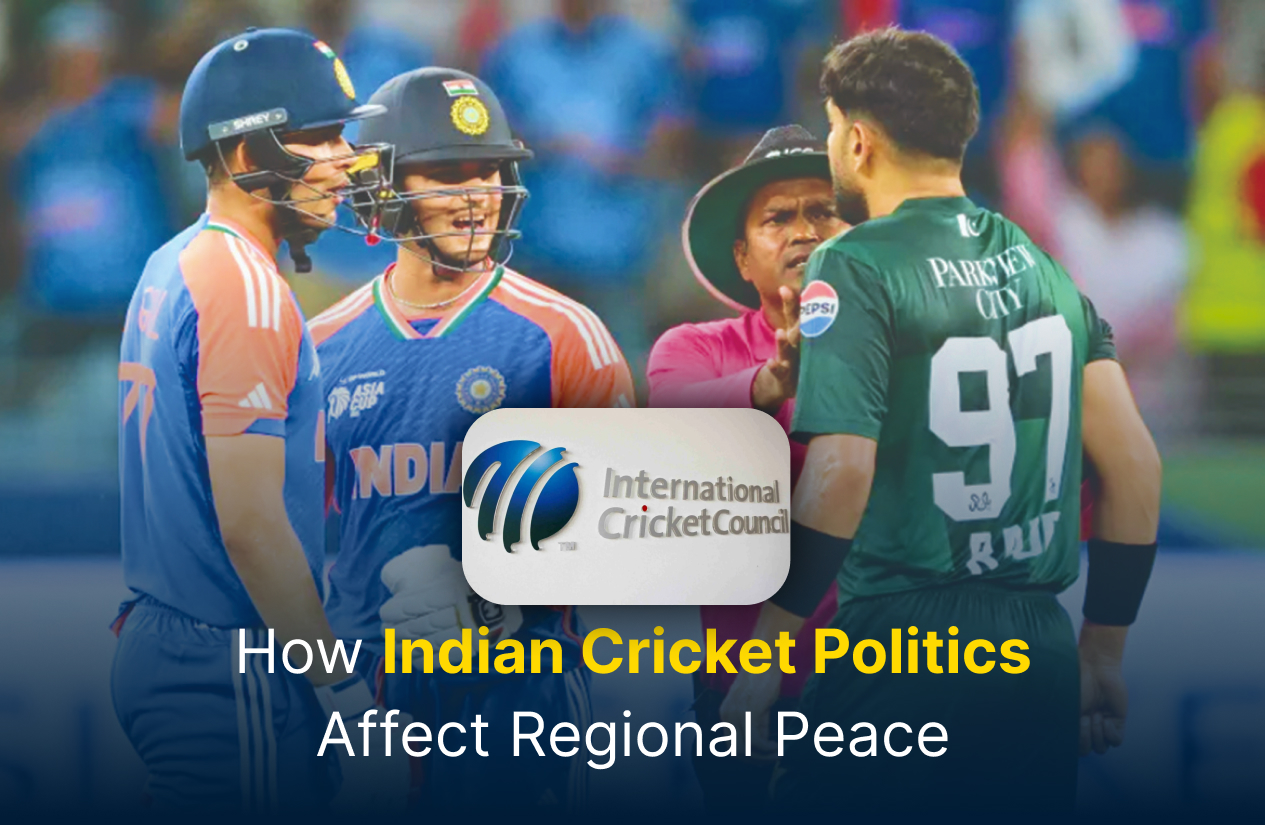

Islamabad - Cricket has never been merely a sport in South
Asia. It is so connected to politics, national identity, and regional relations, particularly those between India and Pakistan. Cricket as an instrument of
diplomacy and people-to-people contact. Cricket can be used as a force for
peace in the South Asian region; however, it has been politically exploited by
Indian authorities against the regional peace process or dialogue. In
juxtaposition, Pakistan has consistently shown readiness to delink sports from
political conflicts and employ cricket as a tool of engagement and détente.
Indian Government’s Politicization of Cricket
Board of Control for Cricket in India (BCCI). BCCI, the most
powerful cricket body in the world, has always followed the Indian government's
stand. A most obvious example is India’s political boycott of bilateral cricket
with Pakistan, though there are no ICC-imposed impediments. This policy has
effectively turned cricket into a political weapon, fanning hostility rather
than tension reduction. In refusing to engage in sports, the Indian authorities
help create a sense of distrust and estrangement that denies millions of fans
on both sides the opportunity for cultural exchange as well as understanding.
Impact on Regional Peace and People-to-People Contact
Sports diplomacy has been used in the past in a positive manner to help bridge the gap between adversarial states. In South Asia, cricket has served as a rare medium of communication during politically fraught times. This channel has been sapped, however, by India’s inflexibility. India’s cricketing freeze on Pakistan, enhancing nationalist rhetoric, space for dialogue declines by distancing itself from Pakistan in the cricket field. India’s cricketing freeze on Pakistan amplifies nationalist luring tales, reducing venues for talks. This line of approach not only influences bilateral relations, but also creates a negative example of bringing international sports into politics, infringing the fair-play spirit between countries in specific and region-wide cooperation in general. One of the arguments of India that falls flat is its capacity to be open for business despite political enmity with others on the issue de jour, all while submitting Pakistan to comprehensive sporting isolation. This selective enforcement of principles lays bare the inconsistency in India’s argument that sports and politics should remain separate. Also, India is still cricketing against Pakistan in the global ICC and multinational competitions (70% commercial windfall; 30% commercial/ viewers doctrine) but not opting for a bilateral series. This shows that it’s not just about security but about political signaling and domestic pose-plunking.
Pakistan’s Constructive and Peace-Oriented Role
Pakistan, on the other hand, has supported that sports
should be kept independent from politics. The PCB has made it clear several
times that we are prepared to play/tour India as long as the security
arrangements are credible and which is acceptable to us. Pakistan, too, has
thrown open its doors to foreign teams again, showing that the rebirth of
cricket can be accomplished far better by diplomacy than isolation. Pakistan’s
overall strategy is grounded in the idea that engagement, particularly
through sports, can mitigate enmity and promote understanding. Cricket
diplomacy gestures, welcoming international teams, and taking part in
multinational competitions are all reminders of Pakistan’s positive
contributions to regional peace. India’s hardline cricket policy is a lost
opportunity. Routine bilateral cricket could be a confidence-building measure
that has the potential to bring down public-level tensions, despite
none-resolution on political differences. Instead, what we get is a strategy
that only hardens divisions, feeds media hysteria, and alienates members of the
public on either side.
Indian cricket politics, to a degree influenced by the state
and nationalist imperatives, have given us more regional straitjackets than
peace. By converting cricket into a political tool, India squanders the power
of sport as a conduit between societies. Pakistan, on the contrary, has largely
stuck to the ethos of sports, arguing for engagement, dialogue, and
people-to-people cooperation. If South Asia is to segue towards sustained
peace, then cricket has to function as a uniting rather than dividing force.
Decoupling these from the sport and encouraging discourse through competition
might help to convert one of the region’s most beloved sports into a true force
for regional cooperation and mutual respect.
By: Asif Sandhu
_6784.jpg)