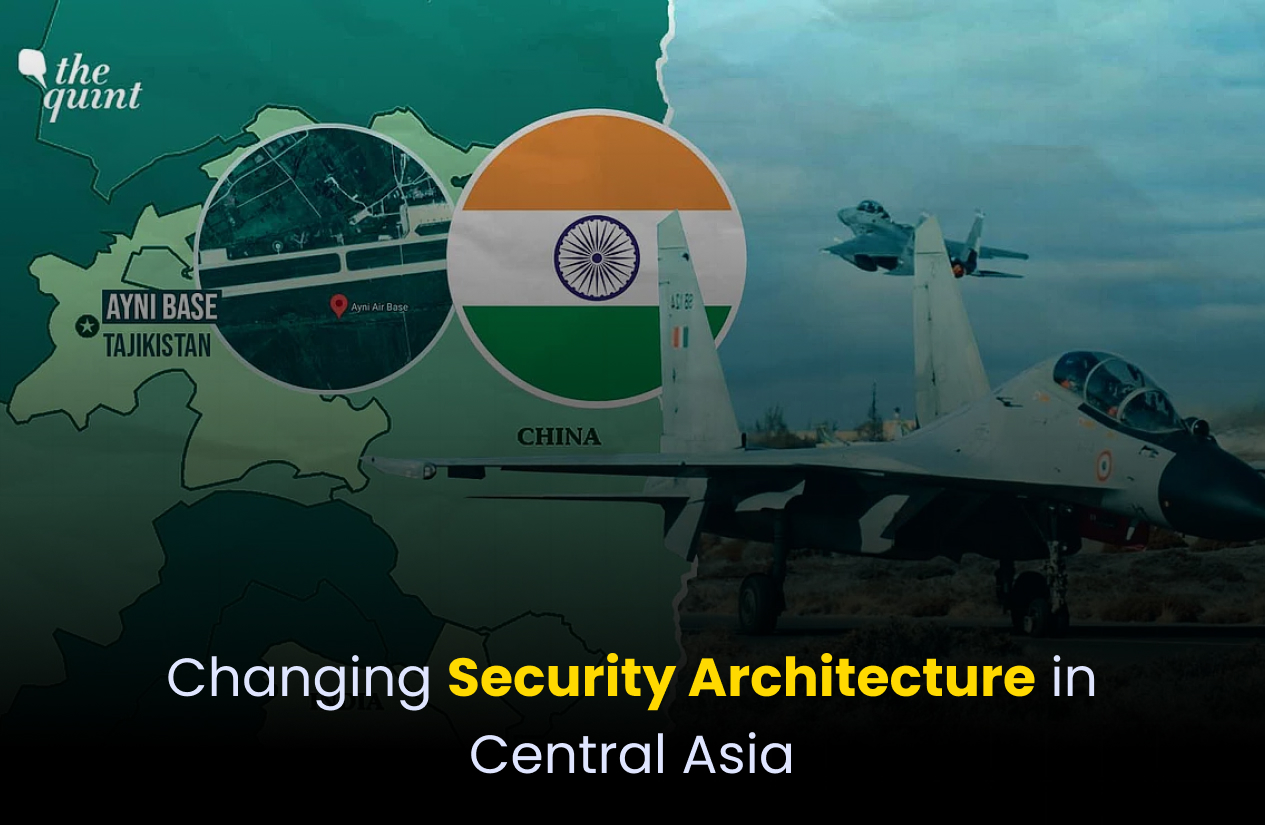

The Indian pull-out of its military base at Ayni Airbase, also known as Gissar Military Aerodrome, in Tajikistan, bringing an end to its solely operational foreign military base, is now complete by October 2025, in line with a 2002 bilateral arrangement. This strategic shift is not in direct response to a Pakistan service directive, although indirectly, it has impacted the strategic setting within the region, as it is now beginning to open up in terms of diplomatic avenues, focusing on peace, dialogue, and regional stability.
Strategic Background:
The Significance of Ayni Airbase built in the Soviet period, the Ayni airbase regained its significance in the early 2000s as India upgraded the airbase to facilitate operations related to the Afghanistan-based Northern Alliance. To the extent of nearly two decades, the airbase was an embodiment of the intentions of India to guarantee itself strategic depth in the Central Asian territory, serving as either a platform to monitor the Wakhan Corridor of Afghanistan or Xinjiang in China.
India had reportedly invested an estimated 70 to 100 million American dollars in upgrading the base from 2002 to 2010. While the Border Roads Organization had upgraded the airfield to handle transport aircraft as well as fighter planes, other installations included hangars, fuel storage tanks, as well as modern air traffic control systems. While temporary use of the Indian Air Force had been reported to have been done, India never gained full sovereignty over the base to operate independently.
The operational deployment of Ayni by India slowly reduced after 2010. A withdrawal with minimal fanfare began in 2022, with a full handover by October 2025. Confirmation came later in 2025 after reports appeared in the media about the expiry of the initial agreement between both countries. Afterwards, the Russian military took operational control of the airbase, and this further cemented the security benefactor status of Russia in the region of Central Asia within the sphere of influence of Russia.
Reasons for Withdrawal
• The underlying agreement from the year 2002 that allows India’s operations expired in 2022, and Tajikistan refused a renewal, thus ending the legal framework that allows Indian operations.
• The fact that a permanent Indian military presence in Kyrgyzstan irritated the Russians in their traditional sphere of influence proved to be a decisive element. It was also reported that a permanent presence could only be in the Collective Security Treaty Organization framework.
• China was opposed to the presence of a non-regional military force proximate to its Xinjiang border. China’s increasing economic as well as security engagements in Central Asia depleted India’s strategic space.
• The reappearance of the Taliban in power reduced the relevance of Ayni, which was previously associated with Afghanistan-agenda-based targets. Although it assisted in the 2021 evacuation of Kabul for India, its relevance reduced post-evacuation.
• There has been an increasing focus of the Indian defense strategy on maritime security and the Indo-Pacific region, seen in investments like the Agaléga airstrip in Mauritius. The idea of a restricted land base without sovereignty has become not so strategic and expensive.
• The withdrawal is the first major scaling back of Indian hard power reach into Central Asia, but some scholars believe a focus on diplomacy, development assistance, and soft power could be more appropriate for India’s strategic sustainability and goals for peace in the regions rather than expensive foreign base construction.
Pakistan’s Role Indirect gains through diplomacy
• Although Pakistan was not a cause for India’s departure, it is anyway leveraging the shifting dynamics in the region.
• Enhanced diplomatic efforts resulted in the signing of a strategic partnership agreement, including high-level visits.
• Regional Connectivity and Energy Cooperation: Initiatives such as CASA-1000 have strengthened Pakistani connectivity in the region with Central Asia.
• Pakistan has used the converging Russia-China relations to position itself as a constructive regional player, especially with regards to Afghanistan.
• These factors have led to a perceptual diplomatic advantage to Pakistan, based on engagement and cooperation rather than conflict.
• The Ayni event highlighted the following general regional lesson: "security in Central Asia will never be a purely military issue and can certainly be enhanced by a combination of military and civilian measures dealing with a wide range of issues beyond national security."
Islamabad Center for Peace and Education (ICPE)
India’s pullout from Ayni has been symbolic of a broader shift in the region from a militarized rivalry paradigm towards a more pragmatic approach. A more stable and enduring peace environment in Central and South Asia can be ensured through structured interactions, joint efforts, and a shared responsibility towards counter-terrorism. Security hegemony through military presence can be a temporary measure, but more meaningful security can be ensured through a trust-building process, increased connectivity, and shared security paradigms.
In a recent article The Indian withdrawal from the Ayni Airbase can be understood as the result of the coming together of various Russian, Chinese, and regional strategic imperatives, in addition to the evolving priorities of the Indian government. Although this represents the end of India’s only overseas military base, it also represents a new age in the region where ‘peace and dialogue are seen as the building blocks of security.
By : Asif Ali
asifsundu.pk@gmail.com

_6784.jpg)