By : Asif Sandhu
ISLAMABAD: Pakistan and Türkiye on Thursday reaffirmed their
commitment towards future forward-looking cooperation in the education sector,
particularly higher education and research area, which can open a new chapter
of bilateral relations in mutual interest as both countries enjoy a strategic
partnership.
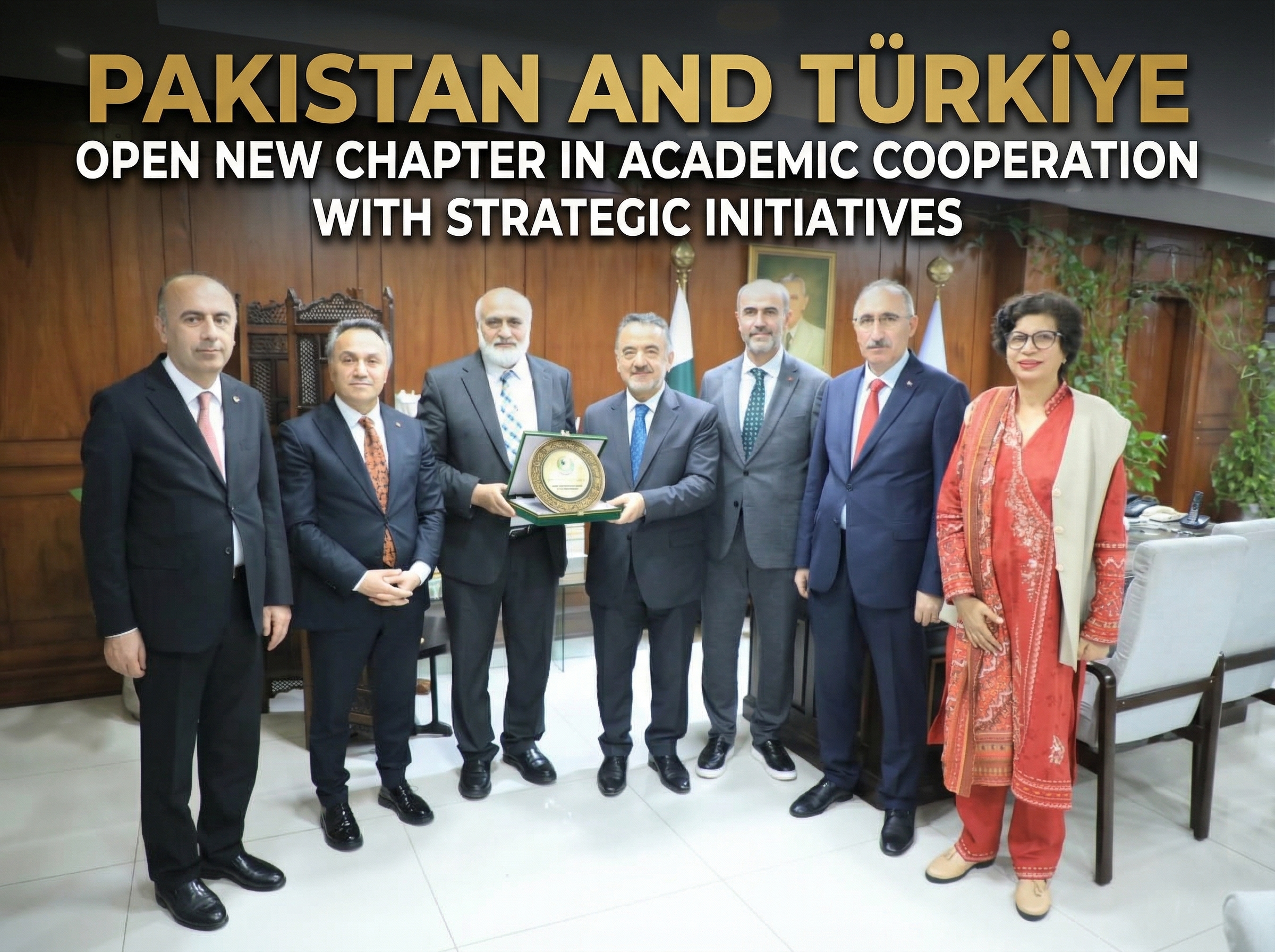
The development occurred during a meeting with the higher
education commission of Pakistan and a Türkiye delegation led by its ambassador
in Islamabad, İrfan Neziroğlu. HEC Chairman Dr. Niaz Ahmad hosted the meeting
and welcomed the delegation, inviting them to strengthen academic collaboration
between the two brotherly countries.
A range of forward-looking initiatives were agreed upon,
which will further enhance cooperation in higher education, research, and
policy development during the discussions. A major output from the meeting was
a proposal to create a Pakistan–Türkiye pool of experts, which would establish
a framework for collaboration in scientific research, strategic studies, and
evidence-based policymaking.
Officials said the effort would allow scholars, researchers,
and policymakers in both countries to work together on emerging global
challenges and share knowledge across disciplines. They also agreed to identify
and send experts as visiting faculty members, enabling joint university
teaching programs and collaboration on research projects between universities
in both countries.
On the occasion, Dr Niaz Ahmad reaffirmed HEC’s focus on
promoting international academic linkages and considered Türkiye as one of the
valued partners in Pakistan’s higher education arena. He emphasized that these
collaborations not only improve academic quality, but also spur innovation,
cultural understanding, and long-term institutional development.
In his statements, Ambassador İrfan Neziroğlu commended
Pakistan for its endeavors to modernize its higher education system and
expressed Türkiye's keen desire to enhance bilateral cooperation in the fields
of sciences, technology, and social sciences. Academic collaboration, he said,
is a key pillar in deepening people-to-people connections and developing sustainable
partnerships.
Let me begin by acknowledging the fraternal ties that bind
Pakistan and Türkiye together — both of our countries enjoy a centuries-old
relationship based on deep cultural affinity, mutual respect, and strategic
alignment. This partnership has evolved over the years and extended into the
education sector through a number of initiatives, such as scholarship programs
for students, faculty exchanges along with collaborative research projects.
This trend is also clearly visible in the growing number of
overseas Pakistanis, especially students who are being financially supported
through government-sponsored and self-funded scholarship programs for higher
education institutions across Türkiye. Since 2020, Turkish universities have
gained international prominence, attracting both local and foreign students,
making them a suitable destination for Pakistani youth pursuing studies in
engineering, medicine, social sciences, and related fields.
Pakistani universities have also taken in Turkish scholars
and researchers, promoting academic exchange and intercultural dialogue between
the two countries. Both countries have also signed Memoranda of Understanding
(MoUs) to foster collaborations in joint degree programs, research, and
academics.
In the last few years both countries have also looked at
collaboration in emerging spheres like artificial intelligence, renewable
energy and public policy, reflecting their desire to use education as a tool
for national development.
The higher education sector of Pakistan has made gradual
progress over the years in terms of better global standings, increased research
output, and improved international linkages. The Commission for Higher Education
Pakistan is one of the founding entities that pushes for university reforms,
university support, and universities in the world.
Pakistan has always had a large academic footprint
internationally, and this collaboration with Türkiye would strengthen that,”
the statement read. Both nations believe that expertise, resources, and
institutional strengths merge to form a vibrant academic ecosystem of
innovation and collaboration.
This initiative marks a well-calculated shift from the
traditional fronts of diplomacy to knowledge-based diplomacy between Pakistan
and Türkiye, according to the Islamabad Center for Peace and Education. The
Center believes that a joint pool of experts can play an important role in
policymaking and policy-based research, and emphasized the need to coordinate
government policies between both countries. The Center emphasized that these
academic collaborations are not limited to education alone, but act as a bridge
for deeper collaboration in regional stability, development, economy, and
technology. It underscored that sustained cooperation among universities, think
tanks, and policymakers will be key to ensuring these agreements lead to
concrete results.
The establishment of the Pakistan–Türkiye pool of experts and
faculty exchange programs is indicative of a forward-looking approach towards
bilateral cooperation. Education officials on both sides indicated hope that
such initiatives would not only help academic institutions but also contribute
to wider diplomatic and economic relationships. The burgeoning collaboration in
higher education between Pakistan and Türkiye is one of the defining pillars
that characterize the historic friendship coming to shape a knowledge-oriented
future for both nations on their seat at the global stage.

_6784.jpg)