
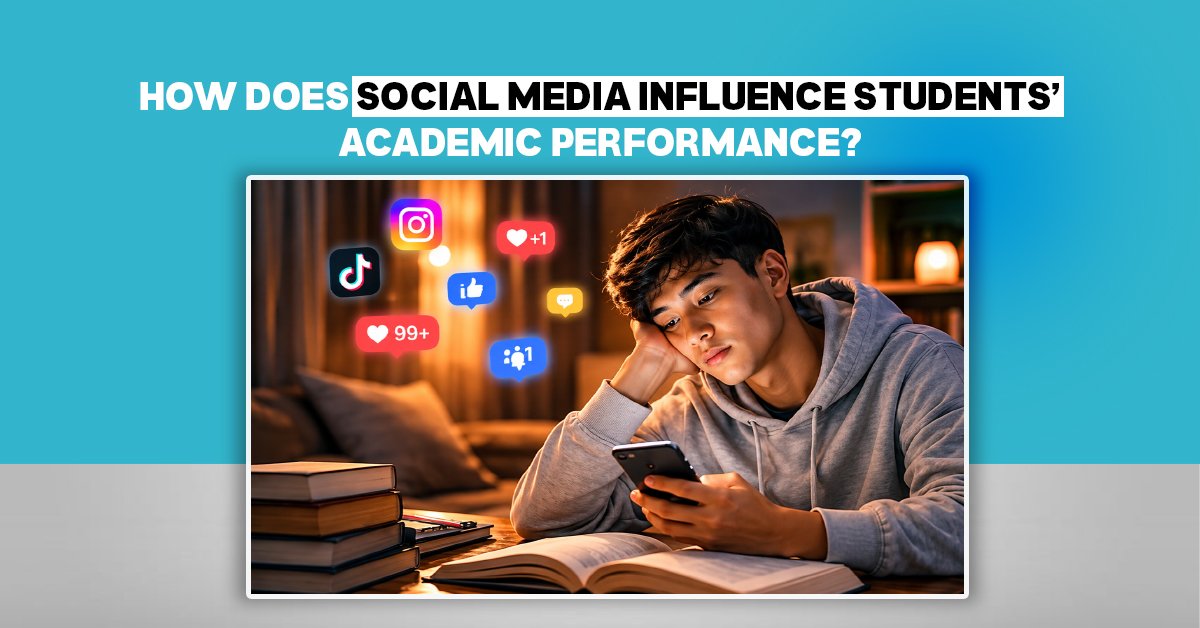

It does not come as a surprise when students today think that social media is responsible for their grades dropping. As it turns out, there are research articles that prove the same. Social Media has rapidly become a central part of the lives of most people. From the usual mindless scrolling to providing a diverse range of perspectives on academic topics, it has undeniably brought about serious changes in people’s lives, those of students as well. For most people, it is the last thing they check before bed, and the first thing they view in the morning. With that in view, it cannot be denied that social media plays a strong role in the academic lives of students. Now, whether that role is positive or negative, is an ongoing debate.
Social media helps students stay in contact with one
another, discuss academic topics and issues, and catch up on events and
lectures that they might have missed. It also helps them reach out to
professionals in their field, and gain valuable experience through online
events and sessions. But these advantages, in my opinion, are temporary. What
needs more attention is the negative effects social media has on the academic
performance of students. Excessive use of social media and its short-form
content (Instagram & TikTok) adversely affect the attention span of
students, and makes it more challenging to focus on studies for a longer span
of time. According to a research conducted by Jamal J. Al-Menayes, social media
platforms are mobile and operate in real-time, allowing students to access them
almost anywhere, including during class. This “always-on” nature of social
media can undermine sustained attention and the cognitive processing necessary
for effective learning. This goes to show how social media affects the
cognitive abilities and attention span of students, and the time they can spend
focusing on academics, is instead spent mindlessly scrolling through social
media.
Another issue that social media raises among students,
is high levels of anxiety and FoMO (Fear of Missing Out). According to a study
by Mcdool et al., students’ mental health got worse when they used social
media. When asked about their lives and schooling, people who use social media
were less satisfied, except for their relationships. A research article by
Zhuliu Gong, Yi Guo, and Jinghao Tan on Social media use and academic
performance among college students, also found that social anxiety and FoMO play
significant roles in the relationship between social media use and academic
performance. It stated that socially anxious people often engage in upward
social comparisons on social media, which can lead to increased feelings of
inferiority and negative self-worth. As a result, their academic motivation and
performance diminish. This proves that excessive consumption of social media
content doesn’t only effect students’ attention span, but also results in
inferiority complex and low self-worth.
So, while social media does provide some facilities to
students, they are more fleeting as compared to the adverse effects it leaves
behind. Constant anxiety, comparison, and loss of cognitive abilities needed
for learning, deteriorate students’ academic performance, and waste the time
that could have been spent on studying, and other academic activities. In my
opinion, it is very important to keep a healthy balance between social media
usage and academics, and not let social media overpower one’s learning process.
Students should show responsibility in how, and in what proportion they consume
social media content, since it can be very powerful tool for improving academic
performance, if used strategically; but its mindless use can also diminish
cognitive abilities and adversely affect one’s academic life. Hence, while
social media has its own list of harmful affects on students, it still wouldn’t
be too wrong to say that the decision of whether it is an academic weapon or a
curse, still lies in the hands of students, and depends on what strategy and
tactics they apply to use it.



_6784.jpg)