In the 21st century, wars are no longer fought solely over territory or
ideology. Instead, natural resources are becoming strategic assets, and among
them, water has emerged as one of the most crucial. The water crisis in
Pakistan is not just a national issue but a daily struggle for millions of
families who wake up without knowing where their next glass of clean water will
come from. The International Organization for Migration (IOM) predicted that
Pakistan will slip into absolute water scarcity by 2035. For Pakistan, water
scarcity is no longer merely an environmental concern; it is evolving into a
national security challenge with economic, political, and geopolitical
consequences. While population growth has undoubtedly increased the demand for
water, the crisis also stems from systematic failures, as nearly half of
Pakistan’s available water is lost due to outdated and inefficient irrigation
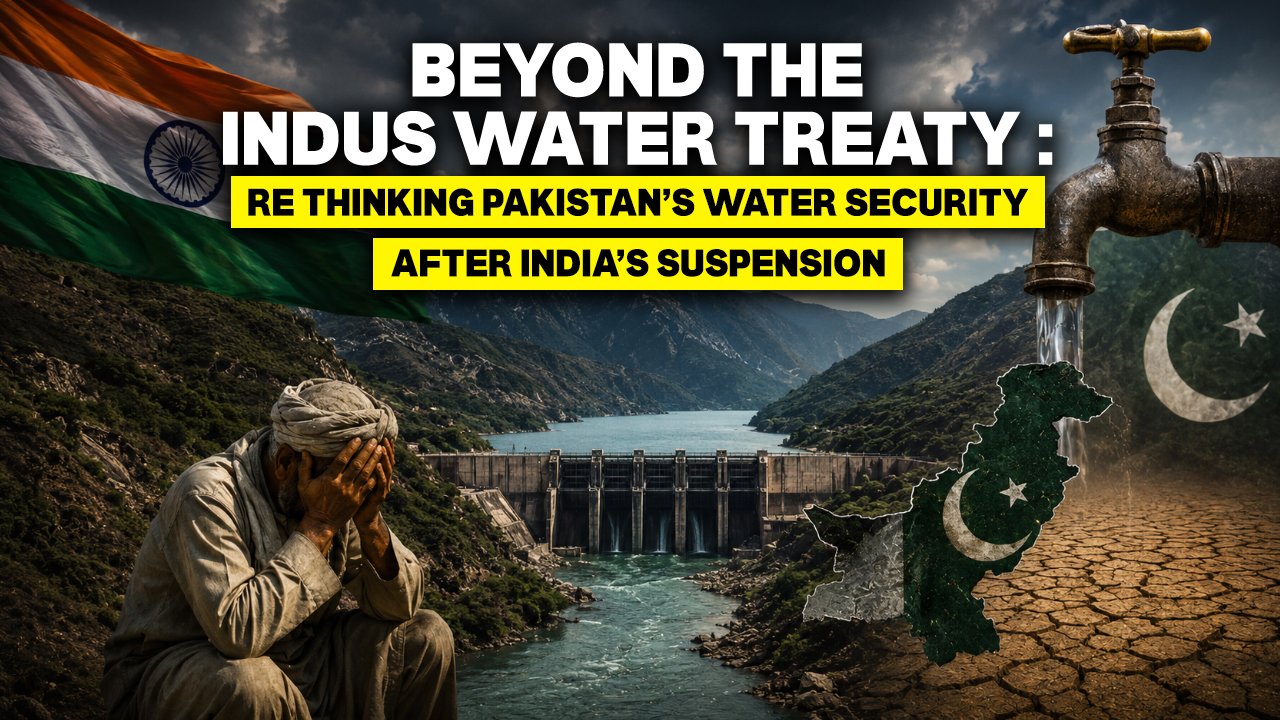
systems. India’s decision to suspend the Indus Waters Treaty has added a new
strategic dimension to an already fragile situation. Rather than viewing the
suspension as merely a diplomatic setback, Pakistan should treat it as an
opportunity to strengthen domestic water governance, modernise its
infrastructure, and adopt proactive water diplomacy.
Pakistan’s annual per capita water availability has declined from over 5,000 cubic metres at independence to nearly 900 cubic metres today, placing it close to the internationally recognised threshold of absolute water scarcity. What contributes to the country’s water crisis are both human-made and natural problems, including climate change, due to which the country has faced unprecedented heatwaves in recent years, causing glacier melting and a rise in sea levels. Along with that, Pakistan’s vulnerability is compounded by its limited storage capacity, preventing the country from effectively storing surplus rainwater or glacial melt for lean periods. Yet these internal challenges became far more urgent after uncertainty emerged around the Indus Waters Treaty.
The Indus Waters Treaty was signed on September 19, 1960, between India and Pakistan and was brokered by the World Bank to address both countries’ concerns regarding the use of the Indus River system. The treaty assigned the waters of the western rivers—the Indus, Jhelum, and Chenab—to Pakistan and the eastern rivers—the Ravi, Beas, and Sutlej—to India. In addition, mechanisms for resolving disputes were provided. However, as the upstream state, India occupies a strategically advantageous position, and disagreements over the interpretation and implementation of certain treaty provisions have caused tensions with Pakistan. For more than six decades, the treaty stood as a testament to the power of diplomacy between two rival nuclear-armed states. However, on April 23, 2025, following the Pahalgam attack, India announced the suspension of the treaty. Since then, India has reportedly ramped up infrastructure development on the western rivers and has aggressively claimed that “not a single drop of water will flow to Pakistan.” Such remarks have caused tension between the two states, as Pakistan has also stated that “any attempt to obstruct the flow of water to Pakistan would be regarded as war.”
However, the suspension exposed Pakistan’s heavy dependence on a single river system and highlighted the need to strengthen its own water-management capacity. Regardless of future diplomatic outcomes, Pakistan cannot rely solely on international agreements to ensure long-term water security. While these challenges are significant, they are not unavoidable. Pakistan’s response must now shift from crisis management to long-term water security.
Irrigation in Pakistan started developing in the late 19th century. At that time, the main goal was simply to reduce the risk of food shortages and help maintain stability in the region. Even today, most of the system still depends on the Indus Basin network, which does a huge job of supporting agriculture. At the same time, a significant amount of water is still lost. Pakistan needs to develop modern irrigation systems because the most sustainable source of new water for Pakistan is not another river but better management of the water it already has. Pakistan also has limited water-storage capacity for monsoon rains and glacier melt, leaving it vulnerable during dry seasons. Investing in new dams, reservoirs, and recharge structures could help the country capture surplus water instead of experiencing floods that leave the country in ruins.
Water scarcity depends not only on how much water a country receives but also on how effectively it manages that water. Lastly, Pakistan should shift from reactive to proactive water governance and diplomacy. It should strengthen domestic water governance through better regulation of groundwater, digital monitoring of water use, and coordinated national planning. These measures should be complemented by proactive water diplomacy to preserve dialogue and cooperation over shared rivers. Long-term water security will depend not only on protecting international agreements but also on strengthening Pakistan’s own capacity to manage its water resources effectively.
Water scarcity has evolved from an environmental concern into a pressing national security challenge for Pakistan. While India’s suspension of the Indus Waters Treaty has intensified concerns over the country’s water future, it also serves as a reminder that long-term water security cannot solely rely on one treaty or river system. Strengthening national water governance, investing in infrastructure, and adopting proactive diplomacy are equally essential. By viewing this challenge as an opportunity for reform rather than merely a crisis, Pakistan can build a more resilient and secure water future for generations to come. In the end, Pakistan’s water security will be determined not only by shared rivers but also by the choices it makes today.



_6784.jpg)