By: Dr. Jamil Akhtar
Restoring Leadership After a
Six-Month Vacuum
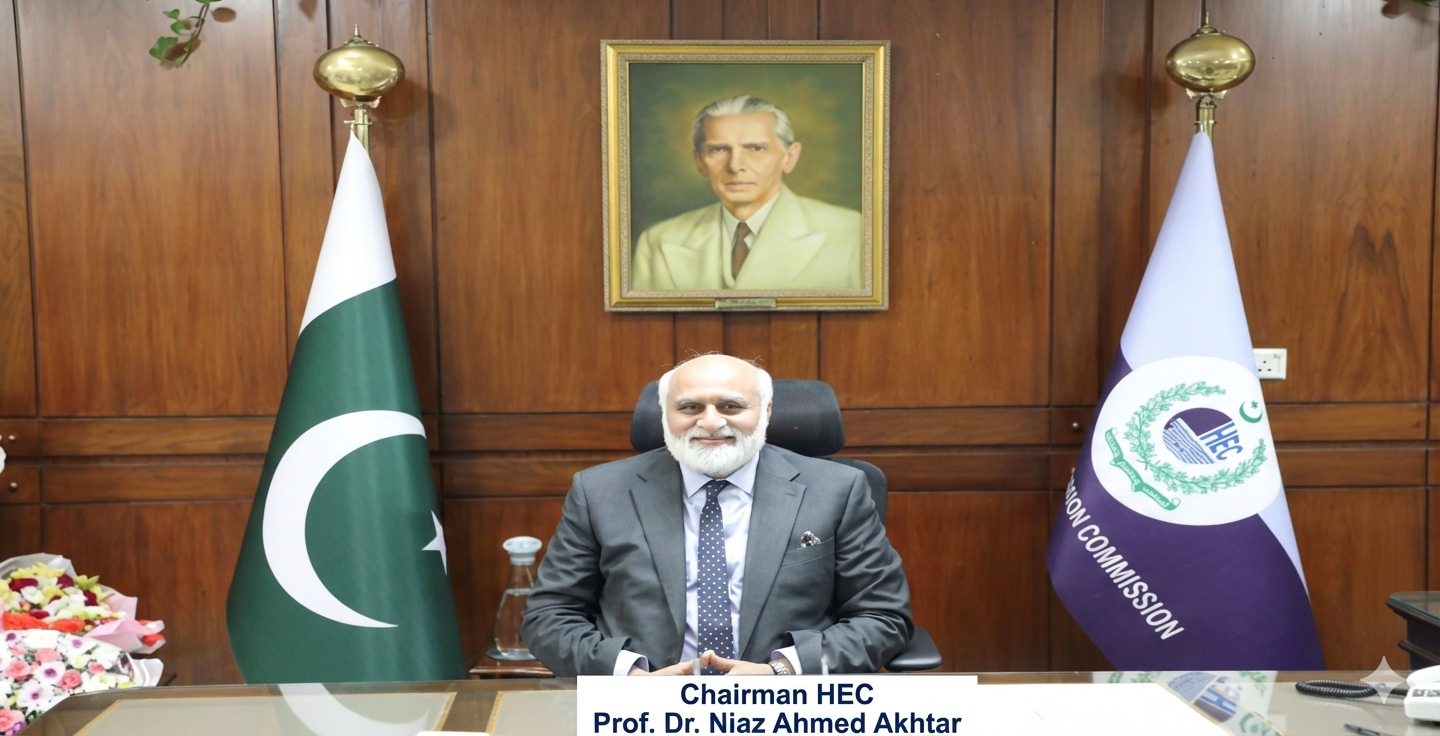
The appointment of Prof. Dr. Niaz
Ahmed as Chairman of the Higher Education Commission (HEC) comes at a moment
when the system urgently needs firm, credible leadership. For the last six
months, HEC had been functioning without a permanent chair, and this vacuum
inevitably slowed the pace of work at every level. Crucial policy files,
institutional decisions, funding approvals, accreditation cases, and long-term
planning exercises require a clear, authorized decision-maker. In a complex
sector such as higher education—where each delay affects universities, faculty,
and students—the absence of permanent leadership translates into uncertainty
and stagnation. By finally filling this key position, the government has
reactivated a vital command centre for higher education and signaled that the
backlog of delayed tasks and strategic initiatives can now move forward with
clarity and confidence.
A Timely and Legally Grounded
Choice by the Federal Government
Equally important is the manner
in which the appointment has been made. The official notification issued on 6
February 2026 by the Ministry of Federal Education and Professional Training
states that the Prime Minister, in his capacity as controlling authority of
HEC, has approved the appointment under the relevant provisions of the HEC
Ordinance 2002 and the subsequent amendments of 2021. This grounding in the
existing legal framework lends institutional strength and legitimacy to the
decision. It demonstrates that the government has not only recognized the
urgency of filling the vacancy, but has done so in a way that is aligned with
statutory procedures and parliamentary amendments. For a body as central as
HEC, such adherence to legal norms is essential to maintaining trust among
universities, provinces, and international partners, all of whom watch the
governance of Pakistan’s higher education sector closely.
A Proven Academic and
Administrator at the Helm
The choice of Prof. Dr. Niaz
Ahmed is particularly encouraging because he comes to the role as a seasoned
academic and an experienced university administrator, not as a transient
political appointee. Known primarily for his contributions in engineering and
technology education, he has served as vice chancellor of major public
institutions, including the University of the Punjab—one of the country’s largest
and most complex universities. Leading such institutions has required him to
manage academic reforms, faculty development, student affairs, and intricate
administrative and financial systems. Over the years, he has been associated
with efforts to strengthen research culture, modernize curricula, improve
governance structures, and uphold academic standards. This background gives him
a rare, system-wide view: he understands from within how public universities
function, where the bottlenecks lie, and what kind of support they need from
HEC to thrive.
Harnessing Experience for a
New Phase of Systemic Reform
With his appointment, the higher
education sector now has at its head someone who has already grappled with
real-world challenges on campuses rather than only viewing them from a
distance. Prof. Ahmed’s familiarity with student dynamics, faculty
expectations, bureaucratic constraints, and resource limitations can be
transformed into more grounded national policies. Instead of abstract
directives, he is well-positioned to champion reforms that are realistic,
implementable, and sensitive to institutional diversity. His leadership creates
the possibility of better alignment between HEC’s strategic objectives and the
day-to-day realities of universities across the country—from large urban
campuses to smaller institutions in developing regions. This alignment is
crucial if reforms are to move from paper to practice.
Re-energising Quality, Access,
and Equity in Higher Education
Under the new Chairman, HEC now
has an opportunity to re-energise three interconnected priorities: quality,
access, and equity. Quality must be strengthened through transparent
accreditation processes, improved faculty development, and support for serious
research rather than a narrow emphasis on numerical targets. At the same time,
access must be expanded for students from low-income families and historically
under-served regions, ensuring that higher education is not a privilege for the
few but a ladder of mobility for the many. Equity demands that universities in
less developed provinces and remote areas receive special attention so that
national progress is not limited to a few urban centres. Prof. Ahmed’s
experience with large, diverse institutions can help shape a balanced approach
that honours excellence while promoting inclusion.
Positioning Universities as
Engines of Peace and National Development
For an organisation such as the
Islamabad Centre for Education and Peace, a particularly promising dimension of
this appointment is its potential impact on social cohesion and peacebuilding.
Universities are not only sites of knowledge production; they are also spaces
where young citizens learn to live with diversity, debate ideas, and engage in
civic life. With a thoughtful national framework, HEC can support programmes in
peace and conflict studies, interfaith dialogue, civic education, and community
engagement. Prof. Ahmed’s system-wide role now allows him to encourage
curricula and research agendas that address Pakistan’s pressing social
challenges—from inequality and extremism to climate vulnerability and regional
marginalisation—so that higher education becomes a deliberate tool for building
a more just and peaceful society.
ICEP’s Suggestions
In light of the appointment of
Prof. Dr. Niaz Ahmed as HEC Chairman, the Islamabad Centre for Education and
Peace (ICEP) respectfully offers the following key suggestions to further
strengthen higher education governance and reform in Pakistan.




_6784.jpg)