
By : Samama Mehar
Imagine a country of 240 million, of which almost two-thirds are aged before 30, and in which three million men and women enter the labor market annually and are unable to be absorbed. This is Pakistan 2026—a nation that occupies one of the most phenomenal demographic reserves in the world, yet fails to translate that reserve into wealth. That growth in GDP is only 2.3% in the FY2026, a long way under the 6% that the economists indicate is necessary to keep up with a growing workforce at this pace. Unemployment among the young people is officially reported at 9.9 percent, though the bigger hurt lies in underemployment: about 30 percent of Pakistani graduates are employed at jobs that do not utilize their education or compensate their potentials.
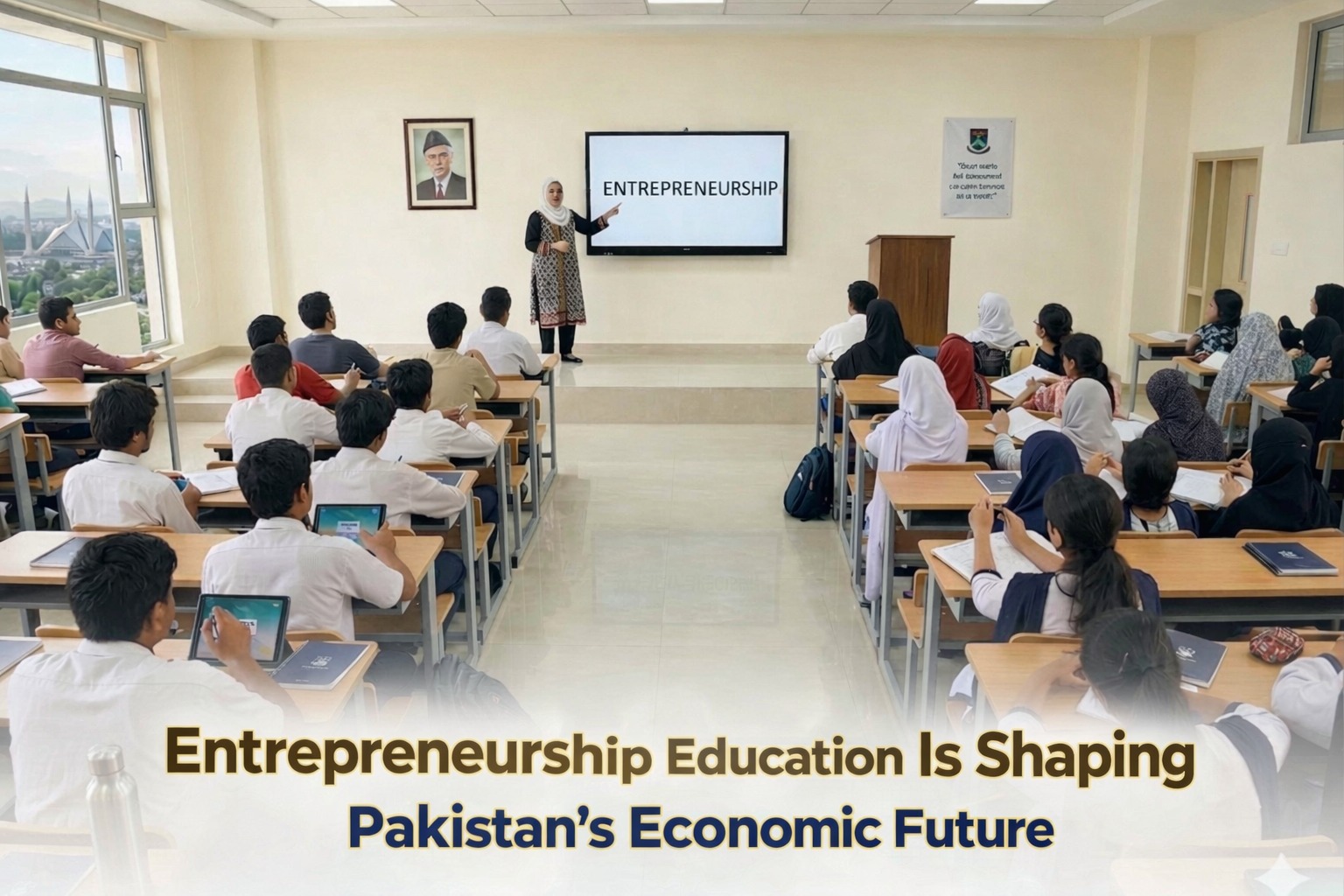
Lack of talent is not the cause of this crisis. It is lack of entrepreneurial thinking. The education system in Pakistan has taken decades to pre-train its youth to become employees and not entrepreneurs. The missing intervention—and the one, it claims, is the most urgently needed—is entrepreneurship education: a strategic, intentional, systematic attempt to show students at all levels the mindset, skills, and audacity to create enterprises, not just resumes.
Already, the small and medium businesses in Pakistan contribute 40% of the GDP and have 80% of the non-agricultural employees. But the majority of these businesses are still informal survival businesses, and not because the founders are less ambitious but due to a lack of entrepreneurial know-how to grow, innovate, and compete. In 2025, the startup ecosystem in Pakistan counted 505 new startup companies, an 11.9% growth rate that has seen the country ranking 72nd on the StartupBlink Global Index with total funding of USD 370 million. These are positive indications, but they are just a drop in the ocean. Fewer than 1 to 2 percent of Pakistani youth are today getting any sort of formal entrepreneurship training. This is what this country needs to bridge.
The business argument of doing so is strong. Studies conducted by the OECD have always indicated that students who obtain structured entrepreneurship education have the highest chance of starting their own businesses, 20 percent higher, and earn 15 percent more in their lifetime as compared to those who do not get such education. A collaboration between SMEDA and the World Bank estimated that a thorough entrepreneurship education reform in Pakistan would accelerate the GDP growth by 2 to 3 percentage points, create 500,000 new SMEs, and create 4 million jobs by 2030. These are not wishful estimates. They are the refined results of the reforms that have already been successfully implemented in other countries.
Pakistan has prepared a true, albeit bumpy, ground. The National Incubation Centers, a program of Ignite in collaboration with NUST, LUMS, and IBA Karachi, have incubated 1,200 startups and generated 18,000 jobs by 2025. Entrepreneurship has become a mandatory course in all undergraduate disciplines in the 2020 curriculum reforms by the Higher Education Commission and is offered by over 200 chartered universities. But the holes are grievous. Over 70 percent of university entrepreneurship programs are instructed by faculty that lack any experience in business at all. At the school level, there is hardly any trace of entrepreneurship: the 52 million children that are enrolled in Pakistan are taught in a school system that still values rote learning more than creative problem solving. Pakistan has only 1% of the start-up ecosystem made up of female founders, which is not only a severe inequity but also a tremendous amount of untapped economic potential. And as Pakistan's venture capital ecosystem has invested about USD 500 million in 2025, it is still small compared to USD 24 billion that is being pumped into the startup domain in India.
The agenda of reform is evident. To start with, at least since Grade 6, enterprise skills, financial literacy, and design thinking should be part of the national curriculum, not an optional extra but a core competency. Second, institutions need to form practitioner faculty pipelines, including entrepreneur-in-residence programs and part-time faculty, into classrooms. Third, university incubators, student startup grants, and regional enterprise centers should be funded by a special-purpose National Startup Education Fund of at least PKR 30 billion, 40 percent of which should be reserved for women and rural youth. Fourth, evaluation should move beyond tests to practical results: business plans, prototype challenges, and live testing in the market. Lastly, gender inclusion should be a mandate that cannot be bargained at all levels of entrepreneurship education.
Countries who have learned this lesson early enough have been paid. Finland incorporated entrepreneurship as its main subject, and it is one of the most innovative economies in the world today. South Korea invested more than USD 2.4 billion in university-linked startup ecosystems and generated globally renowned companies as the outcome. With education reform and its Startup Bangladesh Fund of USD 68 million, Bangladesh was able to produce USD 1.4 billion of IT exports in 2025 alone. There is talent in Pakistan. The institutional will that it requires is the match.
Pakistan is at a crossroads. The business people who will transform this economy already sit in its classrooms and lectures. It is not whether or not the talent is there. It does. The issue is whether the education system of Pakistan is prepared to identify it, nurture it, and release it. Entrepreneurship education is not an academic improvement. It is national infrastructure, without which the future of Pakistan is as it is with roads, power, or water. Incremental thinking is over. What this country requires at this juncture is daring, lasting, and nationwide devotion to developing a generation of creators, not merely applicants.


_6784.jpg)