Top Stories
Building Bridges Through Words Understanding Militant Ideologies in Modern Contexts Security: Beyond Walls and Weapons Upcoming Events: Connecting Ideas and People Previous Milestones: Reflecting on Our Journey Fatwas: Reclaiming the Spirit of Ethical Guidance Role of NATO in Conflict Resolution Washington Peace Deal Between Congo and Rwanda Social Justice and Equality in the Qur’ān: Implications for Global Peace The Qurʾānic Concept of Human Equality: An Analysis against Racism and Ethnic Discrimination in Contemporary Societies Reinterpreting Dhimmitude: A Reconsideration of Its Social and Political Functions in the Modern Context How China Is Playing the Long Economic War Ukraine Peace Efforts Advance Cautiously Despite Partial Alignment Among Parties How Pakistan-Libya Military Relations Strategic Outreach, Economic Stakes and Geopolitical Implications Aleppo Clashes as Syria and Kurdish-Led SDF Agree to Ceasefire Across the Border, Pakistani Ulema Stand Against Afghan Girls\' Education Ban Pakistan announce 500 fully-funded scholarships for Bangladeshi students in 8 programs How theTaliban regime threat for reginal peace Women Left Behind in Khyber Pakhtunkhwa’s Education System Sudan’s Civil War: Anatomy of the World’s Largest Humanitarian Crisis Changing Security Architecture in Central Asia Pakistan Leads India on Economic and Peace Indicators in 2026 : Gallup Survey Submerged Classrooms, Long-Term Learning Loss Pakistan Security Report 2025: Terrorism Trends and the Peace Deficit HEC’s MAKTAB Initiative Signals a New Era for Higher Education Southern Yemen Faces Tensions and Urgent Need for Peace IUT Strengthens Education Integrity in Bangladesh Pakistan’s Arms Sales Contracts (2024–25) and the Peace Dimension Pakistan\'s Contribution to UN Peacekeeping Operations for Global Peace Pakistan Enhances Educational Cooperation with Sri Lanka through Scholarship The Growing Defense and Economic Nexus of the Muslim World Charter of Trump’s Board of Peace Pakistan & Myanmar Prioritize Education Strategic Saudi defense agreements are redefining the Middle East\'s security architecture What would be the consequences of the U.S.–Iran Conflict on Pakistan? How Indian Cricket Politics Affect Regional Peace The Kashmir issue remains a central peace and stability in South Asia American Weapons in Afghanistan Are Destabilizing Pakistan Global Education Coalition sixth annual meeting A New Chapter for Pakistan’s Universities: Leadership, Stability, and Vision under the New HEC Chairman The Evolution of the IMCTC into a Global Security Pillar Reintegration Initiative: Analyzing the 2026 IMCTC Engagement in Pakistan Psychosocial Warfare and the IMCTC Peace Journalists Initiative (2026) The Concept of ‘Ummah’ in the Qurʾān: Transcending Race, Tribe, and Ethnicity HEC Reforms Regulation, Defends Academic Freedom Pakistan’s Evolving Role in Fostering Peace and Security on the African Continent Recontextualizing Pakistan’s Role in the Board of Peace War in the Middle East: Measuring the Cost The Silent Bridge: Pakistan’s Strategic Neutrality and the Quest for Middle Eastern Stability The Geography of Escalation: Living in an Age of Permanent Crisis Mapping the Educational Crisis in the Middle East Conflict The Blind Alley of “Epic Fury”; A War with no End game A Pakistani Voice Against Digital Islamophobia: A Landmark Academic Contribution World Eye on Pakistan for Middle East Peace Leading with Truth, ICEP’s Analysis Outlasted the Skeptics on Middle East Crisis World Powers Push for Deal U.S. Presents 15-Point Plan and Iran Responds with 5 Conditions Pakistan and Türkiye Open New Chapter in Academic Cooperation with Strategic Initiatives Pakistan at the Crossroads of Global Trade as a Logistics Revolution Unfolds Why Ethical Dialogue necessary in a Diverse Pakistan for a Peacebuilding Initiative Pakistan\'s Game-Changer Role for World Peace Entrepreneurship Education Is Shaping Pakistan\'s Economic Future Dr. Jamil Akhtar Featured in Prestigious Brill Encyclopaedia (2026) A Milestone in Global Interfaith Scholarship Peace Light in a Dark Night WAR RESHAPES PAKISTAN’S ECONOMY AND OPEN DOORS FOR INTERPRENEURS From Gaza to Lebanon: ICC, UN, and the Unanswered Duty to Prosecute Can Pakistan turn a temporary ceasefire into lasting middle east peace? Bridging the Gap: Confronting Education Inequality in Pakistan
Security

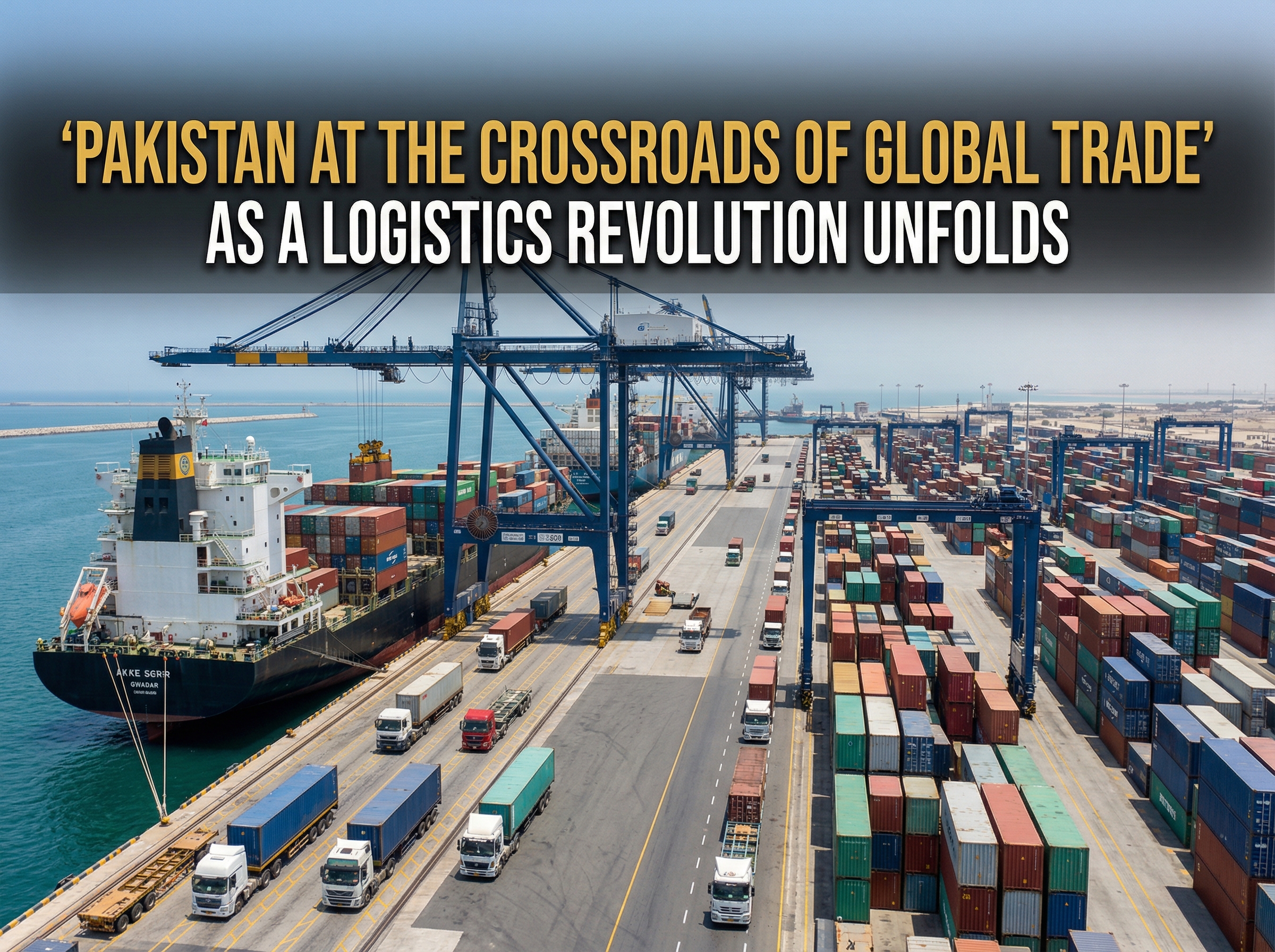
Pakistan at the Crossroads of Global Trade as a Logistics Revolution Unfolds

 By :  Asif Sandhu 


With global trade dynamics on the move and continuing geopolitical tensions engulfing the Middle East, Pakistan is quickly cementing its status as a key focal point in international logistics and transshipment with experts declaring it likely to become a cornerstone of world trade within years.

Regional instability involving Iran, the United States and Israel that disrupted traditional shipping routes has further accelerated this evolution, with global logistics companies being compelled to look for safer alternatives. Increasingly, that alternative is Pakistan.

In Pakistan, major Adam ports due to Karachi Port, Port Qasim and Gwadar Port have seen a explosion in transshipment. Karachi Port alone managed over 8,300 TEUs in 24 days according to recent data, close to the port's total annual transshipment volume last year. Industry analysts have called this surge “unprecedented,” in what is a significant restructuring of regional trade flows. Because of better security and operational consistency, shipping lines that once had depended on Gulf hubs like the Jebel Ali Port and Port of Salalah are now also turning cargo through Pakistani ports.

The shift, experts say, is not just logistical but also psychological, as confidence in Pakistan’s security environment grows worldwide. It has been widely recognized that the security of maritime routes, especially in times of increased tensions in the Gulf region, is critical and for this, Pakistan Armed Forces have played their role. One recent manifestation of this trust came about in the form of oil shipments through the Strait of Hormuz under Pakistani security — something that furthered the country’s reputation as a provider of reliable security.

In a bid to streamline their processes, Pakistani authorities including the Karachi Port Trust have made a slew of reforms to lure foreign shipping lines. These include:

·        Significant reductions in port charges

·        Revised transshipment regulations

·        Dredging and other port infrastructure improvements

The region is also enhancing connectivity to global supply chains, with new feeder services from Pakistani ports to regional trade hubs.

Analysts say this current bump in transshipment activity is more than a passing phenomenon created by war: it may signal the beginning of a lasting transformation in Pakistan’s role in global trade. “Pakistan is no longer a transit corridor; it is becoming a logistics hub with strategic depth,” said a regional trade expert. “If current trends hold, the country could become indispensable to global shipping networks.”

As the drivers of global trade routes mutate to accommodate new geopolitical realities, Pakistan now finds itself at a critical juncture. With its core elements of security, efficiency and strategic interlinking propelling its emergence onto the world logistics map, this is paving the way for a logistics power house. From continued reforms and investment, if this trajectory continues for Pakistan means that it would make a central pillar of the global trade logistics in the future, enabling a cross road market during the next decades—a development capable of even ref reshaping into regional commerce or much efficient worlds supply chain instead.