
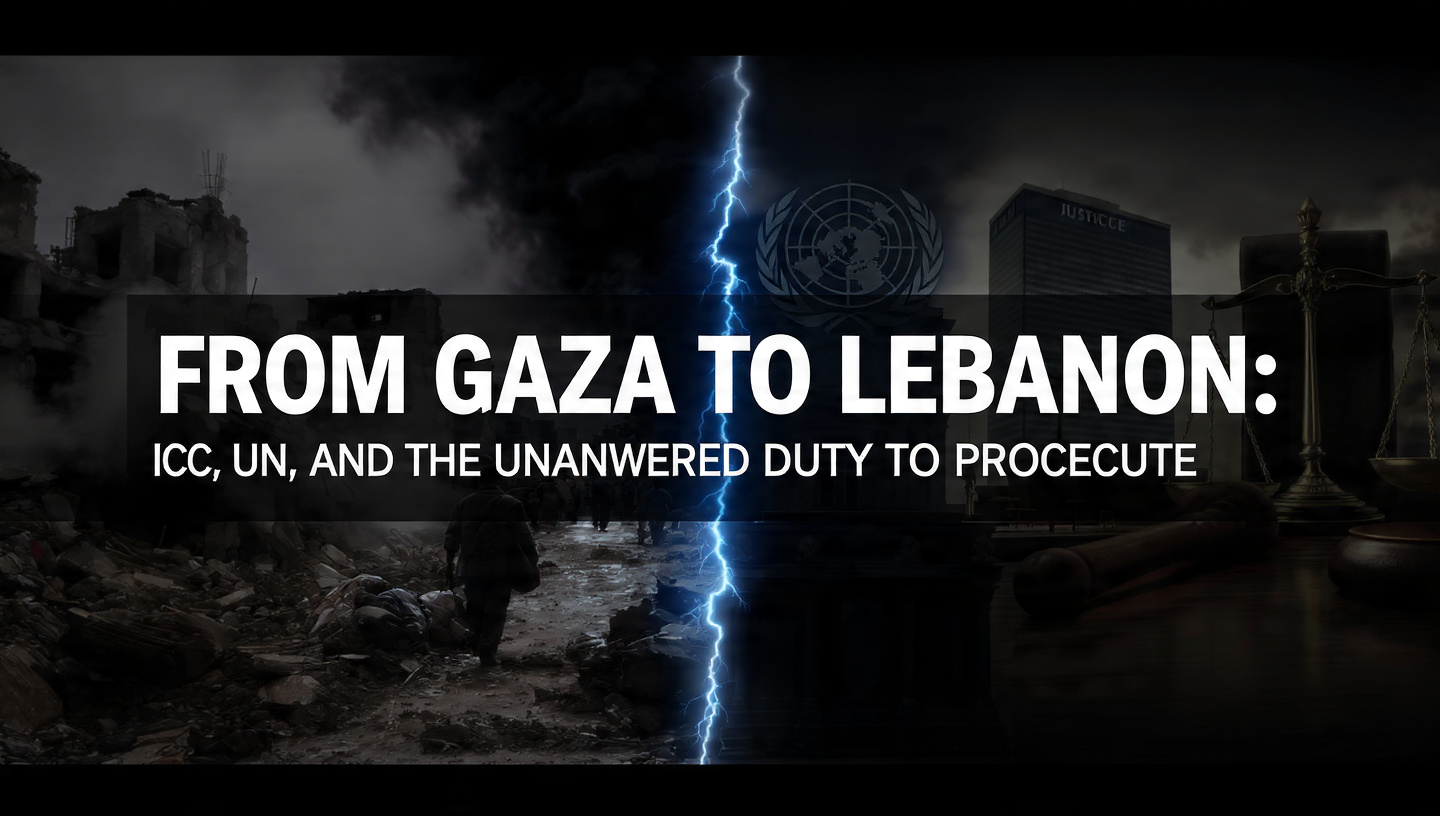

More than a million Lebanese one‑fifth of the
country’s population have fled their homes in the past weeks joining the ranks
of two million Palestinians in Gaza who have been repeatedly displaced under
Israeli evacuation orders. This mass movement of civilians is not the
accidental by‑product of war it is the result of a recurring strategy that
stretches from the camps of Gaza to the villages of southern Lebanon. The Al
Jazeera article detailing Israel’s forced displacement of
civilians in Gaza, the West Bank and now Lebanon makes a powerful case that
what is being described is not mere security planning but a pattern of conduct
that may amount to war crimes and crimes against humanity.
Under international humanitarian law civilians cannot
be forced from their homes except on strictly defined military grounds and any
displacement must be temporary with the right to return guaranteed once
hostilities end. Yet in Gaza and the occupied West Bank Human
Rights Watch and other monitoring bodies have
documented how Israel’s evacuation systems have funneled entire populations
into shrinking zones under constant bombardment making return impossible. The
2025 Operation Iron Wall in the West
Bank
led to the expulsion of 32,000 Palestinians from three refugee camps the
largest displacement in the area since 1967. In Gaza almost all two million
residents were displaced many remain barred from returning even when the
fighting recedes. This is not incidental collateral damage it is systematic,
large‑scale displacement that violates the core principles of the Geneva
Conventions.
Now similar tactics are appearing in Lebanon. Israeli
evacuation orders cover significant portions of southern Lebanon and the
southern suburbs of Beirut affecting predominantly Shia communities and roughly
15 percent of the country’s territory. The Al Jazeera piece notes that more
than a million people have been driven from their homes camping along the
coastline of Beirut a site that has itself been hit by recent Israeli strikes.
The declared intention matters as much as the facts on the ground when Israeli
Defence Minister Israel Katz publicly states that displaced Shia residents of
southern Lebanon “will not return” until Israel’s northern communities feel
secure, the language shifts from temporary safety to permanent exclusion. That
formulation grounded in religious and geographic identity raises the spectre
less of tactical necessity than of politically driven ethnic restructuring.
Within this context the role of the International
Criminal Court and the United Nations becomes central and deeply troubling. The
ICC has opened investigations into alleged war crimes committed in Palestine
including forced displacement, attacks on civilians, and the use of starvation
as a method of warfare. Yet, despite these efforts no senior Israeli officials
have faced real legal consequences. The court’s jurisdiction is strong in
principle but its power is hollowed out by political resistance from major
states that shield Israel from arrest warrants and sanctions. The result is a
court that signals accountability but fails to enforce it offering symbolic
gestures instead of concrete deterrence.
The UN’s record is similarly inconsistent. UN
experts have repeatedly warned that Israel’s displacement
policies in Gaza and the West Bank resemble war crimes and crimes against
humanity. Some UN mechanisms have highlighted the deliberate nature of this
displacement and the systematic prevention of return. Yet the Security Council
bound by the veto power of permanent members has not adopted binding
resolutions that would compel compliance or sanctions. Strong statements are
issued follow‑up actions are watered down or blocked. For displaced Lebanese
and Palestinians, the gap between rhetoric and reality is the distance between
the promise of international law and the reality of impunity.
Critics will argue that Israel faces asymmetric
threats from armed groups such as Hezbollah and Hamas, and that evacuation orders
are necessary to protect its own population from rocket attacks and
infiltration. There is no doubt that states have a right to self‑defense but
that right does not extend to the mass long‑term expulsion of civilians or the
denial of their right to return. Human Rights Watch has shown that Israel’s
evacuation corridors have often led civilians directly into areas under
bombardment and that the authorities have not genuinely explored alternative
measures that would protect both civilians and security. When displacement is
so large‑scale so long‑term and so explicitly tied to permanent non‑return it
ceases to be a security tactic and becomes a policy of collective punishment.
From Gaza to Lebanon, Israel’s strategy of forced displacement reveals a dangerous pattern: territories are reshaped not only by concrete and tanks but by the quiet erasure of entire communities. The International Criminal Court and the United Nations have the legal tools and the moral responsibility to confront this pattern. Yet, year after year, they fail to translate investigation and commentary into prosecution and enforcement. If the ICC and the UN continue to defer to political convenience the message is clear for some states, war crimes can be committed with impunity and for millions of displaced civilians the law offers only empty promises.
Disclaimer: The views expressed in this article are solely those of the author and do not necessarily reflect the position of ICEP.

| Nida Awais is a student of Peace and Conflict Studies in National Defence University Islamabad and also serving as a member of HEAL Pakistan Organization, an initiative dedicated to promoting Humanity, Education, Awareness and Leadership. She can be reached at itsnida.a22@gmail.com |


_6784.jpg)